




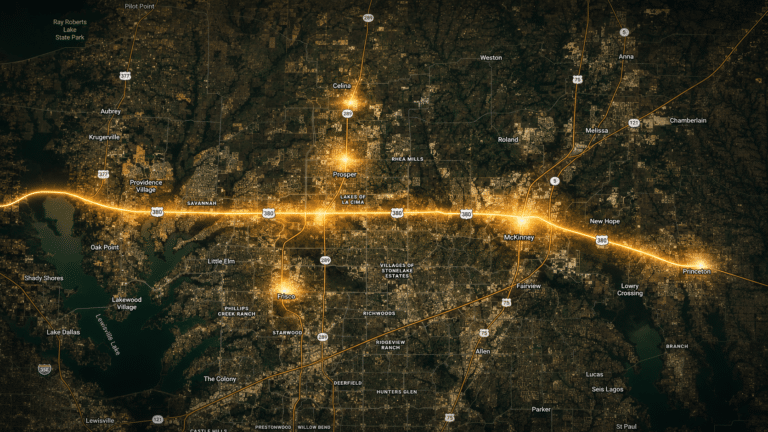




Why the US 380 Corridor Is One of the Fastest-Growing Areas in North Texas
If you’re not familiar with the US 380 Corridor, then you’re not from the DFW. If you’re moving to town, then it’s a route that you will soon know well enough. When it comes to well-known North Texas growth areas, this corridor handily leads the charge.
What was once a primarily rural stretch of US 380 has now become a hotspot for commercial and residential construction. New communities, schools and retail centers are popping up seemingly overnight and major transportation upgrades are quickly following suit so as to keep pace with this remarkable demand. With all of this in mind, you may be wondering why the US 380 Corridor is one of the fastest-growing areas in North Texas. Let’s consider the causes behind this unprecedented escalation.
Location, Location, Location
The stretch that runs from Frisco and Prosper, through McKinney and Princeton is what astronomers might call the “Goldilocks Zone.” This term is generally applied to interstellar planets that are perfectly suited for life as a result of a nearby star. That description also applies here: it’s just a matter of geography.
The US 380 Corridor sits in the path of northward expansion from Dallas and Plano while still offering room to grow in both Collin and Denton counties. As a result, a number of perfectly located communities, such as Prosper, Celina, Frisco and McKinney, provide residents with a practical lifestyle balance. They are close enough for a commute to the big cities and employment hubs but also far enough out for large-scale communal development. This means one can call the DFW metro home while also appreciating what it means to ease into a less-is-more lifestyle.
The Best Cities in Texas Are Right Here
In a recent article, Celina and the aptly named Prosper were listed as the two best Texas cities to live in. This is the very sort of press that developers rely on. Commuters zipping along the US 380 Corridor are often surprised by how fast the residential and commercial sectors of these previously modest Texas towns have erupted. The charge in both communities is led by new housing, strong schools and a solid, notable investment in infrastructure.
In fact, all of the surrounding communities are flexing some development that is attracting national attention. Regional population estimates from the North Central Texas Council of Governments (NCTCOG) illustrate how the growth in these areas is really taking off. In its 2025 estimates, the area added more than 234,000 residents. Celina, McKinney and Princeton rate among the top gainers with Celina noting almost 16,000 new residents in a single year. That constitutes almost a 35 percent increase in population. Imagine waking up tomorrow and realizing that your city population has expanded by more than a full third. That’s not incremental; that’s an eruption.
Transportation and Infrastructure Lead the Way
Infrastructure and transportation are key when it comes to properly expanding. Generally speaking, most developers know how to plan accordingly. However, the traffic volumes along the US 380 Corridor have surged so much that it has forced the hand of the Texas Department of Transportation (TxDOT). The 380 is undergoing considerable upgrades as more lanes, turn lanes and improved medians are added.
These projects are part of a broader vision to widen much of US 380 into a six-to-eight lane freeway with available frontage roads for Denton and Collin Counties as funding and environmental review allow. In practical terms, this means that today’s construction efforts will result in a more “freeway-like” corridor, one that will be able to support continued growth in the area for decades to come.
The Big “E” Fuels US 380 Corridor Growth
As James Carville is famous for saying, “It’s the economy, stupid.” The US 380 Corridor growth in North Texas is largely fueled by a stable, growing economy as the DFW metro continues to attract major corporate hubs and expansions. This results in higher-wage jobs and that means an influx of new residents will continue to pour in.
In fact, a recent report by the CBRE lists Dallas-Fort Worth as the nation’s top destination for corporate headquarters relocation. When a metro adds 100 corporations, it increases the competition for that local housing market. As a result, those communities along the US 380 Corridor are absorbing a big share of that “Dallas Flex” because those communities offer newer inventory and proximity to large employment hubs around Plano, Frisco and Richardson.
So, yes, that big economic upturn can and will “jump” the corridor. As companies expand into established business districts, employees will look outward for more attainable and affordable housing with shorter commutes. In effect, the US 380 Corridor is primed to capture spillover demand and it’s clear that those nearby communities are taking full advantage of that situation. They are able to do this by investing in strong infrastructure, solid housing and expanding on one of the more celebrated school systems in the country.
If you’re considering a move to the DFW metro, you have likely researched many of the amazing communities and suburbs the area has to offer. If you want to take advantage of the North Texas growth areas, then you’re not alone. The growth in this particular region is hot to the touch and ready for you.
If you have any questions about relocating to or around the US 380 Corridor, then please don’t hesitate to call or contact us online. IMS Relocation has been serving the DFW area for more than 30 years. This means we know the area well and we can help you to better understand how to get moved and settled into your new community. Just reach out today and ask one of our relocation experts about your free, no-obligation quote.
